English
English


Views: 0 Author: Site Editor Publish Time: 2026-07-09 Origin: Site


Schools are investing rapidly in AI learning environments, STEM labs, maker spaces, and interactive science areas. Yet buying an AI Interactive Demonstration Wall is not the same as purchasing a standard classroom screen. A demonstration wall combines physical modules, artificial intelligence, sensors, mechanical structures, educational content, and interactive experiences into one long-term campus installation.
That difference matters during procurement. A school may find a system impressive during a short demonstration but discover later that it does not fit the available wall space, curriculum, student age group, maintenance capacity, or future expansion plans. Before approving an AI Interactive Demonstration Wall for schools, administrators should evaluate much more than visual appearance.
To maximize educational value and long-term return on investment, schools should examine the system through a practical lens: learning relevance, modular flexibility, installation requirements, hardware durability, AI interaction quality, customization, maintenance, and vendor support. This guide explains what to check before purchasing an AI Interactive Demonstration Wall and how to run a structured pilot before wider deployment.
Start with learning objectives: Choose modules that support real curriculum goals, STEM learning, AI literacy, science exploration, or campus science communication.
Evaluate modularity and space: A school interactive STEM wall should fit the installation area and allow future expansion or module replacement.
Check hardware durability: Frames, sensors, mechanical components, power systems, and interactive parts must withstand frequent student use.
Look beyond individual features: The strongest AI Interactive Demonstration Wall should create a coherent learning experience rather than a collection of disconnected gadgets.
Plan for training and maintenance: Teachers and administrators need simple operation, accessible support, and clear procedures for maintaining modules over time.

Many educational technology products use similar terms, but an AI Interactive Demonstration Wall is fundamentally different from an interactive flat panel. A normal interactive panel is primarily a digital screen used for presenting, writing, casting, and running classroom software. An interactive demonstration wall is a physical learning environment made up of multiple educational modules that students can see, touch, control, and explore.
For example, WEEEMAKE’s solution uses modular structures that can combine AI, sensors, lighting, mechanical mechanisms, screens, and other interactive components. Different modules can demonstrate concepts such as face recognition, gesture interaction, voice control, coding logic, engineering mechanisms, geography, renewable energy, and other STEM topics.
This distinction should shape your purchasing criteria. Do not evaluate an AI Interactive Demonstration Wall according to screen brightness, whiteboard latency, or casting performance. Instead, ask whether the system makes abstract concepts visible and understandable. Can students interact with the underlying mechanism? Can teachers connect the activity to a lesson? Can the wall remain useful outside a scheduled classroom period?
Before testing any product, define the educational problems you want it to solve. A school may want a STEM makerspace wall for project-based learning, an AI education wall for introducing machine learning concepts, or a science exhibition wall for corridors and campus open days. Clear objectives prevent schools from buying an impressive installation that students stop using after the first few weeks.
The first consideration is curriculum relevance. An AI Interactive Demonstration Wall should support more than entertainment. Review the available modules and map them to subjects, grade levels, and learning outcomes. A strong system should help students connect physical interaction with concepts from AI, coding, physics, engineering, geography, biology, or other STEAM disciplines.
Next, evaluate modularity. School spaces vary widely, and a fixed one-size-fits-all installation can create unnecessary limitations. A modular AI interactive wall for schools should allow administrators to select different themes, adjust the overall layout, and add or replace modules as educational priorities change. This is especially important for schools building long-term AI labs or technology culture spaces.
Physical durability also matters. Students will press buttons, move mechanisms, speak to voice modules, trigger sensors, and repeatedly interact with the equipment. Check the strength of the frame, mounting system, exposed components, connectors, switches, and moving parts. Ask how damaged or worn modules can be repaired or replaced without dismantling the entire AI Interactive Demonstration Wall.
Installation requirements should be reviewed early. Measure the available wall dimensions, surrounding circulation space, electrical access, mounting surface, and student viewing height. Consider whether the system will be placed in a classroom, corridor, lobby, library, makerspace, or dedicated AI laboratory. An effective school AI interactive wall should fit naturally into the environment rather than forcing the school to redesign the entire space around the equipment.
Finally, examine scalability and customization. Schools often begin with a limited number of modules and expand later. Confirm whether additional modules can be integrated into the existing structure. Ask whether themes, graphics, language, software, or interaction content can be adapted to local curriculum requirements. This flexibility can significantly extend the useful life of the investment.
An AI Interactive Demonstration Wall can serve several functions depending on where it is installed. Schools should compare different AI interactive demonstration application scenarios before choosing the final module combination and layout.
In an AI lab or STEM classroom, the wall can become a large-scale teaching station. Teachers can use AI recognition, sensor technology, mechanical engineering, programming, and robotics modules to demonstrate principles before students move into smaller group projects. This creates a bridge between explanation and hands-on experimentation.
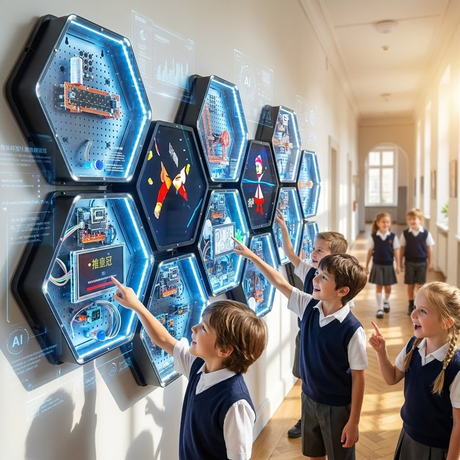
In corridors and shared learning areas, a school corridor interactive wall can turn previously passive space into an informal science-learning zone. Students can explore short interactive activities between classes without waiting for a teacher to prepare equipment. Modules related to scientific principles, puzzles, smart sports, geography, energy, and AI can encourage repeated interaction over time.
For geography and interdisciplinary learning, a Voice Interactive Smart Map can combine speech recognition with geographical knowledge. Students can interact with map content through voice and receive information about continents, oceans, and related topics. Within a broader AI Interactive Demonstration Wall, this type of module helps schools connect AI technology with conventional subject learning.
AI concepts can also be made tangible through modules such as an AI Face Detection Gate. In an educational demonstration context, students can observe how computer vision detects facial features and controls a simulated access mechanism. The educational value is not simply the output; it is the opportunity to discuss how recognition systems work, where they are used, and what limitations or ethical questions they raise.
School lobbies, innovation centers, and open-day spaces provide another application. A well-designed AI Interactive Demonstration Wall can communicate a school’s approach to STEM education while still remaining useful to students every day. Visitors see an active learning environment rather than a static poster or conventional digital signage.
Campus Zone | Recommended Interactive Focus | Primary Educational Benefit |
|---|---|---|
AI / STEM Lab | AI recognition, coding, sensors, robotics | Supports structured hands-on AI and STEAM learning |
School Corridor | Science principles, puzzles, interactive challenges | Encourages informal learning between classes |
Main Lobby | High-visibility AI and technology demonstrations | Combines student learning with school innovation showcase |
Makerspace | Engineering mechanisms, coding, robot integration | Supports project-based and interdisciplinary learning |
Science Exhibition Area | Energy, physics, geography, biology themes | Makes abstract scientific principles visible and interactive |
An AI Interactive Demonstration Wall must work reliably under repeated real-world use. Start by testing every interaction type. Voice recognition should respond consistently in the actual installation environment. Gesture or posture recognition should work at realistic student distances. Buttons, sensors, motors, visual interfaces, and mechanical structures should respond without confusing delays.
For AI-enabled modules, administrators should ask how processing is handled and what hardware is required. Some systems can perform image recognition, voice interaction, or other AI functions locally, while others may depend on external computing or network services. Understanding the architecture helps schools plan connectivity and evaluate what happens if the network is unavailable.
Safety should be treated as a core procurement requirement. Check whether frames and modules are securely mounted, whether corners and moving mechanisms are appropriate for the intended age group, whether cables and power supplies are protected, and whether frequently touched components can tolerate heavy use. A classroom or corridor installation may receive far more physical contact than equipment in a controlled exhibition booth.
Maintenance access is equally important. Ask whether individual modules can be removed independently, how replacement parts are supplied, and whether troubleshooting documentation is available. A modular system provides the greatest long-term value when a single failed component can be serviced without taking the entire AI Interactive Demonstration Wall out of use.

Technology delivers little value if teachers do not know when or how to use it. The interface and interaction flow of an AI Interactive Demonstration Wall should be simple enough that educators can incorporate selected modules into lessons without turning every activity into an IT project.
Review the vendor’s training resources carefully. Teachers should understand the learning objective behind each module, the basic operating process, and possible classroom extensions. For a STEM makerspace wall, training should go beyond switching equipment on and off. Educators need examples of how a demonstration can lead into coding, robotics, engineering, science inquiry, or group discussion.
Schools should also consider unsupervised or semi-supervised student interaction. One advantage of an AI education demonstration wall is that certain modules can remain available in corridors, halls, or technology corners where students can explore them during breaks. To make this sustainable, instructions must be intuitive and the hardware must tolerate repeated use.
A peer-led training model can improve adoption. Identify teachers who already lead STEM, computer science, robotics, or maker activities. Train them first and let them develop lesson examples for colleagues. When teachers see how the AI Interactive Demonstration Wall supports existing subjects rather than adding an entirely separate workload, adoption becomes much easier.
The purchase price is only one part of the total cost. Before comparing vendors, request a clear breakdown of design, hardware, software, installation, customization, freight, training, warranty, replacement modules, and after-sales support.
Modular expansion should also be included in the financial plan. If the school wants to add new AI or science themes in two years, can it purchase additional modules without replacing the original structure? If one module is damaged, can it be replaced independently? These questions often matter more than small differences in the initial quotation.
Customization can affect both cost and long-term usefulness. Schools may need different wall dimensions, language versions, branded graphics, curriculum-specific themes, or a specific combination of AI and STEAM modules. Confirm which modifications are included and which require separate engineering fees.
The best AI Interactive Demonstration Wall is not necessarily the system with the largest number of modules. It is the one that delivers the strongest educational value per module, fits the available environment, remains maintainable, and can grow with the school’s program.
Do not approve a large deployment based only on exhibition demonstrations or sales videos. Ask shortlisted suppliers to show relevant school projects, technical documentation, and documented AI exhibition system cases. Real installations provide useful evidence of how the hardware performs in classrooms, corridors, science centers, or high-traffic education environments.
A structured Proof of Concept does not need to reproduce the entire final installation. It should test the most important modules and operational assumptions.
Week 1: Space and Installation Review. Confirm wall dimensions, mounting requirements, power access, student reach, visibility, and traffic flow.
Week 2: Core Interaction Testing. Test voice, gesture, vision, sensors, buttons, mechanical components, and other selected interactive functions with real students and teachers.
Week 3: Curriculum Integration. Ask teachers to use selected modules in STEM, AI, science, geography, coding, or maker lessons. Record whether the demonstrations genuinely improve explanation and student participation.
Week 4: Durability and Support Review. Inspect components after repeated use, test basic maintenance procedures, and submit a support request to evaluate the vendor’s responsiveness.
Use a strict vendor checklist at the end of the pilot. Can the supplier provide a layout that fits your exact space? Are modules replaceable and expandable? Can content be customized? Is teacher training available? Are installation and maintenance instructions clear? Does the vendor have experience delivering AI Interactive Demonstration Wall projects for education environments?
If the answer to several of these questions is unclear, resolve them before signing a large contract.
Buying an AI Interactive Demonstration Wall is not simply an equipment upgrade. It is a decision about how a school wants students to encounter artificial intelligence, science, engineering, and interactive technology in everyday campus life.
The strongest solutions combine meaningful content, reliable hardware, modular expansion, safe installation, simple interaction, curriculum relevance, and long-term support. Schools should avoid choosing a system based only on visual impact or the number of features shown during a short demonstration.
Your immediate next steps should be practical:
Define the learning objectives for your AI lab, STEM classroom, makerspace, corridor, or science exhibition area.
Measure the installation environment before selecting the wall size and module combination.
Match interactive modules to curriculum topics and student age groups.
Review durability, maintenance, customization, and expansion options.
Ask vendors for real project references and conduct a focused Proof of Concept before large-scale deployment.
A carefully selected AI Interactive Demonstration Wall can become more than a technology showcase. It can create a visible, touchable learning environment where students repeatedly explore AI and STEAM concepts through real interaction.
An AI Interactive Demonstration Wall is a modular educational installation that combines interactive hardware with technologies such as sensors, computer vision, voice interaction, mechanical systems, coding, and AI. Unlike a standard interactive flat panel, it is designed to let students physically explore scientific and technological concepts through multiple demonstration modules.
Schools can install an AI Interactive Demonstration Wall in AI labs, STEM classrooms, makerspaces, corridors, libraries, lobbies, innovation centers, and science exhibition areas. The best location depends on whether the primary objective is formal teaching, informal student exploration, campus showcase, or a combination of these functions.
Customization depends on the supplier, but modular systems can support different wall dimensions, module combinations, themes, graphics, languages, and curriculum requirements. Schools should confirm customization scope during the design stage and request a layout based on the actual installation space.
Evaluate educational relevance, hardware durability, modular expansion, safety, customization, installation support, replacement parts, training, and documented project experience. A reliable AI interactive wall manufacturer should be able to explain both the educational purpose of the modules and the practical requirements for long-term operation.
Compare AI Interactive Demonstration Wall suppliers using the same procurement checklist rather than simply comparing prices. Review the proposed module configuration, installation plan, curriculum fit, warranty, after-sales response, upgrade options, customization capability, and real education projects. This makes it easier to identify the solution that offers the best long-term value.