English
English


Views: 0 Author: Site Editor Publish Time: 2026-07-15 Origin: Site


Student engagement remains one of the most persistent challenges in modern education. Traditional displays, posters, and presentation tools can deliver information efficiently, but they often keep students in a passive role. Learners watch, listen, and receive information without having many opportunities to touch, test, question, or explore what they are seeing.
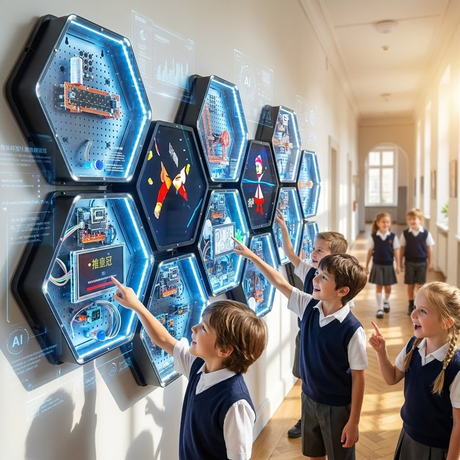
An AI Interactive Demonstration Wall changes that learning dynamic. Instead of functioning as a single presentation screen, it combines interactive modules, AI technologies, sensors, mechanical structures, voice control, gesture recognition, and hands-on activities into one learning environment. Students are encouraged to approach the wall, trigger an interaction, observe the response, and understand the principle behind it.
For schools building AI labs, STEM classrooms, maker spaces, innovation centers, or interactive corridors, this approach can turn unused wall space into an active learning zone. More importantly, an AI Interactive Demonstration Wall for student engagement gives learners repeated opportunities to participate physically and cognitively rather than simply consume digital content.
This guide explains how an AI Interactive Demonstration Wall supports active learning, which types of modules can increase participation, how schools can measure engagement, and what educators should consider before introducing this technology into daily teaching.
From viewing to doing: An AI Interactive Demonstration Wall gives students a reason to touch, speak, move, test, and respond instead of only watching content.
Multi-modal interaction: Gesture recognition, voice interaction, sensors, visual feedback, and mechanical movement can engage different forms of student participation.
Concrete AI learning: Interactive modules make concepts such as computer vision, recognition, automation, logic, and engineering easier to observe and discuss.
Engagement beyond class time: A school interactive demonstration wall can support both structured lessons and informal exploration in corridors, lobbies, and STEM spaces.
Teacher integration still matters: The strongest engagement comes when interactive modules connect to clear learning objectives rather than functioning as standalone attractions.
Traditional classroom technology often focuses on delivering information. A teacher presents slides, shows a video, or writes on a digital board while students remain primarily observers. These tools can support instruction, but the interaction is usually concentrated around the teacher rather than distributed among students.
An AI Interactive Demonstration Wall changes the role of the learner. Instead of asking students only to look at information, it gives them something to do with it. A learner may use a hand gesture to control a game, speak a command to activate a system, trigger a sensor, operate a mechanism, or test how an AI recognition module responds to an input.
This creates a more direct feedback loop. Students take an action, observe the result, form a question, and try again. The wall therefore becomes an environment for exploration rather than a one-way presentation surface.
That distinction is especially important for hands-on AI learning for students. Artificial intelligence can feel abstract when introduced only through definitions such as machine learning, computer vision, or natural language processing. When students see a camera recognize an object, use a gesture to control a task, or give a voice instruction that changes a physical response, the technology becomes easier to understand.
An interactive learning wall for schools can also support a wider range of participation styles. Some students engage through movement. Others respond strongly to visual change, sound, problem-solving, or mechanical cause and effect. By combining several types of interaction in one environment, an AI Interactive Demonstration Wall can give more students an entry point into the learning activity.
Student engagement does not come from artificial intelligence alone. It comes from the way technology turns a concept into an action students can understand.
The first mechanism is immediate response. When students perform an action and the system reacts clearly, they can see the relationship between input and output. A gesture may move an object. A spoken command may activate a function. A sensor may trigger a light, sound, or mechanical response. This short feedback loop encourages students to experiment repeatedly.
The second mechanism is physical participation. Many AI and STEM concepts are normally taught through text, diagrams, or code. An AI Interactive Demonstration Wall adds movement and physical interaction. Students are not limited to clicking through a software interface. They can stand in front of a module, move their hands, manipulate a mechanism, compare sensor readings, or work with classmates to complete a task.
The third mechanism is visible cause and effect. Interactive modules can make hidden processes easier to discuss. Teachers can ask students what the system detected, why a response occurred, what input changed, or how the mechanism could be improved. This supports inquiry-based learning and encourages students to explain their reasoning.
The fourth mechanism is variety. A modular AI learning wall for schools can combine AI recognition, logic games, engineering mechanisms, smart-home simulations, geography, energy, and other STEAM themes. Students therefore encounter different forms of challenge rather than repeating the same interaction format.
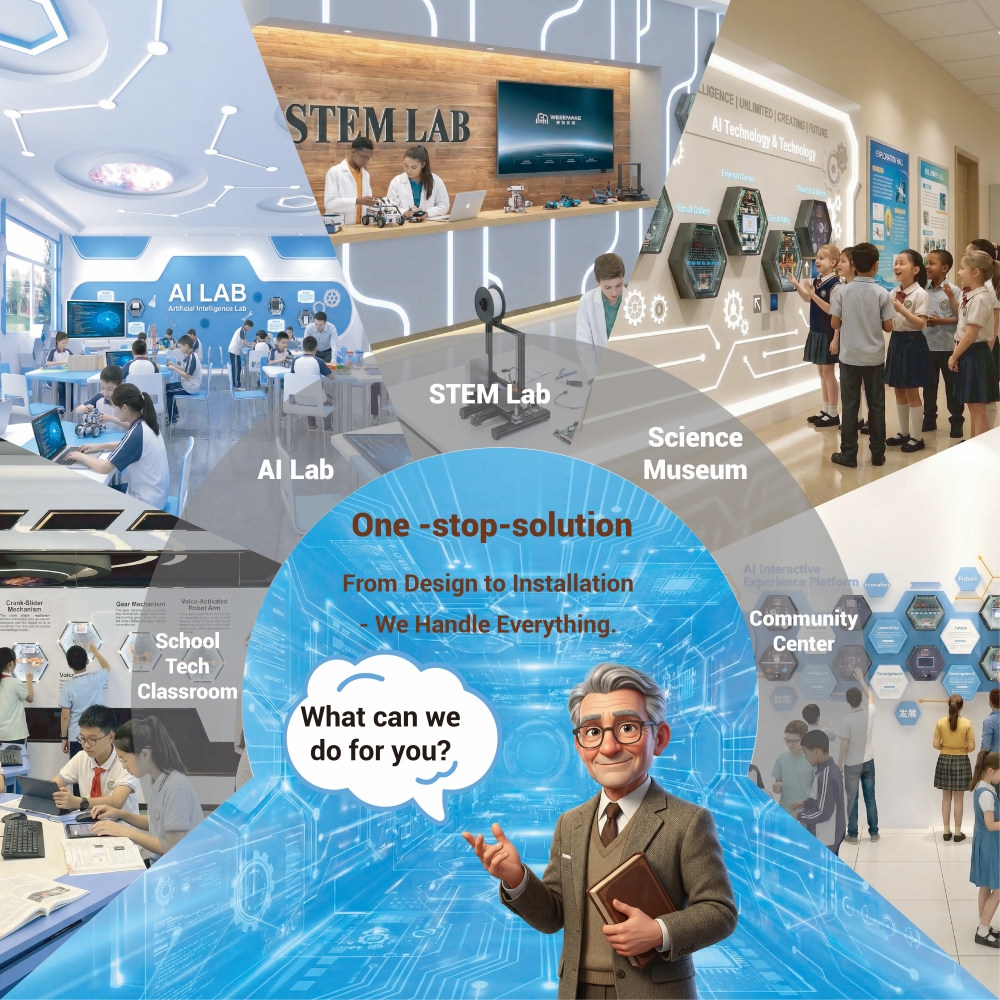
WEEEMAKE's AI Interactive Demonstration Solution is built around this modular approach, with demonstration tools that introduce AI concepts such as facial recognition, gesture control, voice interaction, image recognition, and other hands-on activities. A school can combine modules according to its available space, student age group, curriculum focus, and intended learning environment.
The clearest way to understand the engagement value of an AI Interactive Demonstration Wall is to examine what students actually do with it.
Gamification can turn abstract reasoning into a visible challenge. A Gesture Control Sokoban Game uses gesture recognition to let students control the classic Sokoban puzzle through hand movements. Instead of using a conventional controller, learners interact through physical gestures while thinking about sequence, space, and the consequences of each move.
This type of module supports more than entertainment. Students must observe the current state, predict what will happen next, choose an action, and correct mistakes. The physical interaction makes the task more noticeable and can encourage classmates to discuss possible solutions together.
A Hanoi Tower module can support similar problem-solving goals. The Tower of Hanoi is a familiar logic challenge based on sequencing and planning. Within an interactive STEM learning wall, it gives students a concrete problem they can attempt, repeat, and explain. Teachers can extend the activity by asking learners to compare strategies, count moves, or describe the logic behind an efficient solution.
AI modules make engagement more meaningful when they connect a familiar task with a real application of artificial intelligence. An AI Garbage Recognition module can help students explore how image recognition can be applied to waste classification. The activity creates an opportunity to discuss both AI technology and sustainability, linking computer vision with an everyday environmental problem.
A Smart Home Assistant provides another form of interaction. Students can explore voice commands and environmental information such as temperature, humidity, light intensity, and sound level, while observing simulated smart-home functions. This gives teachers a practical starting point for discussing sensors, automation, voice interaction, IoT concepts, and how smart systems respond to changing conditions.
Together, these modules show why an AI interactive wall for STEM education can be more engaging than a single-purpose teaching device. Students move between logic, AI recognition, voice interaction, environmental sensing, and physical problem-solving. Each activity asks them to participate rather than simply watch.

Different school environments require different types of engagement. An AI Interactive Demonstration Wall can support several learning formats when schools select modules intentionally.
Learning Environment | Typical Interaction | Engagement Benefit |
|---|---|---|
AI / STEM Classroom | AI recognition, gestures, sensors, coding concepts | Makes abstract technology easier to observe and discuss |
Makerspace | Engineering mechanisms, automation, problem-solving | Encourages experimentation and project-based thinking |
School Corridor | Short games, puzzles, interactive challenges | Creates informal learning opportunities between lessons |
Innovation Center | Multi-module AI and STEAM demonstrations | Supports group exploration and school technology showcases |
Science Exhibition Area | Physics, energy, environment, geography, AI | Connects scientific concepts with visible cause and effect |
In a formal lesson, a teacher can use one module as a demonstration before asking students to complete a related activity. In a makerspace, learners can compare the demonstration with their own robot, coding, or engineering project. In a corridor or common area, short interactions can encourage voluntary exploration outside scheduled class time.
This flexibility is one reason an AI Interactive Demonstration Wall can support engagement across the campus. It does not need to replace classroom instruction. Instead, it creates another layer of contact with AI and STEAM concepts.
Engagement is not always an individual activity. Interactive installations can also create opportunities for students to observe and learn from one another.
When one student attempts a gesture-controlled puzzle, classmates often watch the result and suggest the next move. When a voice-controlled system responds unexpectedly, students may discuss why. When a sensor produces a different reading, learners can compare conditions and propose an explanation.
An AI Interactive Demonstration Wall can therefore act as a shared problem-solving space. The physical scale of the wall makes interactions visible to a group, allowing students to participate as users, observers, advisers, and explainers.
For teachers, this creates opportunities to ask open questions:
What did the system detect?
Why did it respond that way?
What would happen if we changed the input?
Can you predict the next result?
How could this technology be used in real life?
What are the limitations of this AI function?
These questions move the activity beyond novelty. They turn the school interactive demonstration wall into a starting point for discussion, reasoning, teamwork, and reflection.
Schools should not evaluate an AI Interactive Demonstration Wall only by how impressive it looks on installation day. Engagement needs to be observed over time.
The most useful indicators are often behavioral rather than technical. Teachers can track whether students voluntarily approach the wall, whether they repeat an activity to improve their result, whether they discuss the module with classmates, and whether the interaction generates questions connected to the lesson.
Schools can also compare engagement before and after introducing an AI Interactive Demonstration Wall into a STEM lab, makerspace, or corridor. Useful indicators may include:
Engagement Indicator | What to Observe |
|---|---|
Voluntary Participation | How often students choose to interact without being prompted |
Repeat Interaction | Whether students return to a module or try again after failure |
Peer Collaboration | Whether students discuss strategies or help classmates |
Time on Task | Whether learners remain focused during the activity |
Concept Discussion | Whether the interaction leads to relevant questions or explanations |
Transfer to Projects | Whether students connect the demonstration to coding, robotics, science, or engineering work |
These measures provide a more realistic view of engagement than simply counting device uptime. A wall may be switched on all day but still have little educational impact. The better question is whether students are actively thinking, experimenting, communicating, and applying what they observe.
For an AI Interactive Demonstration Wall for student engagement, repeated voluntary use is particularly valuable. If students return to a module because they want to solve a challenge, understand an AI response, or show a classmate how something works, the installation is supporting curiosity rather than forced participation.
Even a highly interactive system needs teacher support. Schools should avoid treating an AI Interactive Demonstration Wall as a self-contained attraction that automatically improves learning.
The first step is familiarization. Teachers need to understand what each module demonstrates and how students are expected to interact with it. They do not need deep technical expertise, but they should be able to connect the activity with a curriculum concept.
The second step is lesson integration. A gesture game may support logic and sequencing. AI Garbage Recognition may lead into a discussion of computer vision, classification, sustainability, or data. Smart Home Assistant can introduce sensing, automation, IoT, and human-machine interaction. The educational value increases when teachers connect the demonstration with questions, experiments, worksheets, coding activities, or student projects.
The third step is student independence. Some modules should be simple enough for learners to explore with minimal guidance. This is particularly important when the AI Interactive Demonstration Wall is installed in a corridor, library, innovation center, or shared STEM space. Clear instructions and intuitive interaction allow students to learn during breaks or open activity periods.
A phased adoption model can help schools build sustainable use:
Teacher Familiarization: Educators learn the purpose and basic operation of the selected modules.
Guided Demonstration: Teachers introduce one or two modules during relevant lessons.
Student Exploration: Learners interact independently or in small groups.
Curriculum Extension: Activities connect to coding, robotics, engineering, AI, science, or maker projects.
Peer Sharing: Teachers exchange lesson ideas and successful classroom applications.
This approach helps the AI Interactive Demonstration Wall become part of the learning environment rather than a feature that is heavily used only during the first month.
Schools should evaluate engagement features according to learning outcomes, not novelty. A gesture-controlled activity is valuable when it gives students a meaningful problem to solve. Voice interaction is useful when it helps learners understand how intelligent systems receive and process commands. Mechanical modules are effective when students can connect movement with an engineering principle.
Before choosing an AI Interactive Demonstration Wall, ask vendors practical questions:
Evaluation Area | Questions to Ask |
|---|---|
Educational Relevance | Which AI and STEAM concepts does each module demonstrate? |
Student Interaction | What does the student physically do, and what feedback does the module provide? |
Age Appropriateness | Which grade levels are best suited to each activity? |
Modularity | Can modules be added, replaced, or rearranged later? |
Curriculum Integration | Can the solution be matched to school subjects or learning themes? |
Durability | Are frequently touched and moving components designed for repeated student use? |
Installation | What wall space, power access, and mounting conditions are required? |
Training | Are teachers shown how to connect modules with learning activities? |
Customization | Can graphics, language, themes, or module combinations be adapted? |
Support | How are damaged modules diagnosed, repaired, or replaced? |
A short pilot can also help. Instead of evaluating the wall only through a supplier demonstration, let a small group of students and teachers interact with selected modules. Observe whether instructions are intuitive, whether students remain interested after the first attempt, and whether teachers can connect the activity to real lessons.
The strongest AI Interactive Demonstration Wall should generate questions as well as answers. Students should want to understand why the system behaved in a certain way, how the technology works, and how they might build or improve something similar themselves.
An AI Interactive Demonstration Wall improves student engagement by changing the learner's role. Students do not simply receive information. They move, speak, test, observe, solve, compare, and discuss.
Gesture recognition can turn logic into physical interaction. AI recognition can connect machine vision with real-world applications. Smart-home modules can make sensors and automation visible. Engineering and puzzle modules can encourage repeated problem-solving. Together, these experiences support a more active form of AI and STEAM education.
For schools, the goal should not be to install the largest or most visually impressive wall. The goal is to create an AI Interactive Demonstration Wall that students continue to use because the activities are understandable, challenging, relevant, and connected to what they are learning.
Start by defining the engagement goals for your AI lab, STEM classroom, makerspace, corridor, or innovation center. Select modules that support those goals. Train teachers to connect each interaction with a clear concept. Then observe how students use the wall over time.
When implemented thoughtfully, an AI Interactive Demonstration Wall can turn a passive school space into an environment for hands-on AI learning, exploration, collaboration, and repeated discovery.
An AI Interactive Demonstration Wall is a modular educational installation that combines technologies such as AI recognition, gesture control, voice interaction, sensors, mechanical structures, and other STEAM demonstration modules. It is designed to let students explore concepts through physical interaction rather than only viewing information on a screen.
An AI Interactive Demonstration Wall encourages students to take actions and observe immediate results. Depending on the module, learners may use gestures, voice commands, sensors, puzzles, or mechanical interactions. These activities can promote curiosity, repeated experimentation, discussion, and collaborative problem-solving.
No. An AI Interactive Demonstration Wall can be installed in AI labs, makerspaces, science rooms, libraries, corridors, lobbies, innovation centers, and exhibition areas. Schools can select different modules according to the learning objectives and available space.
Schools should evaluate educational relevance, module variety, durability, ease of interaction, curriculum fit, installation requirements, customization, maintenance, and teacher support. An effective interactive learning wall for schools should encourage repeated student participation while remaining practical to operate over the long term.
Yes. An AI Interactive Demonstration Wall can make AI concepts more tangible by allowing students to interact with examples of gesture recognition, voice interaction, image recognition, automation, and sensing. These demonstrations can serve as starting points for deeper lessons in coding, robotics, AI, engineering, and other STEAM subjects.